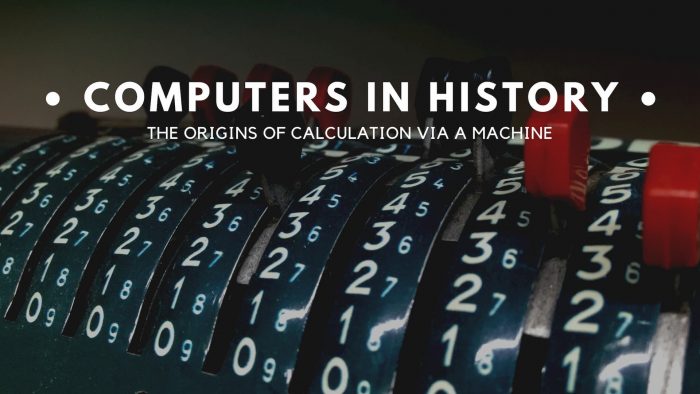

Many people claim that computing began in the eighties and others who know a little more say that it did in the thirties. Both this classes of thinkers recall huge processors that could measure as half a house and consuming what today is considered an enormous amount of electric power. But in reality the foundations of what today we generally know as computing comes from many more years ago, even thought it was a “different” computing…still it was a form of “computing”.
First let’s see the etymology of the word COMPUTATION: it comes from the Latin “computatio”, which means “count” or “calculation”. But it may be more accurate to use the word COMPUTERS to refer to this issue, since computing itself is the automatic processing of INFORMATION through computers.
However, taking into account that computing is, in other words, calculating, let’s go back some 5000 years. Around 3000 B.C. Chinese civilization had already invented the abacus (which could be the first calculator), and at this point they performed more complex calculations than in other times. Centuries later, and with the natural need of man to simplify his environment, patterns are discovered in order to minimize the results of severe operations in simple additions. In the end these additions, following these patterns, gave the same result as the tedious multiplications.
This was called “logarithms”, thanks to the Scotsman John Napier (1550-1617). Thanks to the contributions of the great scientific-mathematical minds of that time such as the Frenchman Blaise Pascal (1623-1662), the German Gottfried Wilhelm Leibniz (1646-1716) and the also German Wilhelm Schickard (1592-1635) took some of the enormous steps for the evolution of calculus. Pascal invented a machine to add, similar to what we know today as a “hand counter”, the problem with this was that you could not make equations with very large numbers. Later, Leibniz added to his own invention the possibility of being able to add, subtract, multiply and divide with a machine of considerable but effective size. However, among these three, Schickard takes all the credit; for being the creator of the first automatic calculator, which he himself called “calculating clock”. This calculating watch was based on “Napier’s bones” (first type of multiplication table) and could do the four basic operations with numbers up to six digits. And this was only the beginning.
The Englishman Charles Babbage (1791-1871), influenced by the mathematical inventions and methods already mentioned, created a steam engine with mechanical differences in order to calculate tables of numbers. He drew up a design for a machine to run tabulation programs, although he was never able to carry out the manufacturing. Babbage named it a “differential engine” and this was the first prototype of what we now know as a computer.
Twenty years later Babbage manufactured his second calculating machine, which he called the “analytical machine”, this machine was based on a loom made by the French Joseph Marie Jacquard (1752-1834): this loom was better known as “The Jacquard loom”. The loom worked by punched cards; to be able to weave fabric patterns and thus obtain more complex designs and produced independent movement. Interestingly, the holes in the cards passed the threads in BINARY order.
The nineteenth century was ending and the American Herman Hollerith (1860-1929) developed a mechanical system to calculate and group censuses with punch cards. He invented the “tabulating machine” and the duration of censuses (which in the United States could last from 10 to 12 years counted manually) he minimized them to two and a half years. Hollerith founded the Tabulating Machine Company in 1896, which within a few years and with many structural changes later became the International Business Machines Corporation (IBM).
From there, the history of the computing world would change drastically thanks to figures such as Vannevar Bush (1890-1974) and his idea Memex (Memory-Index) which consisted of a device with a keyboard and levers with access to data stored in microfilms. and the English Alan Turing (1912-1954) known for Cryptographic Analysis (breaking of codes), the Turing test that was one of his most abstract studies (about artificial intelligence) among other topics.
At this precise point, what I call a technological “revolution” was generated. Man, as the most intelligent being on the face of the Earth, will not stop surprising or innovating.
Nobody really knows what inventions we will see in 50 years from now. Hopefully each and every one of them will be used for good purposes where all mankind can benefit.

Digital Designer, blog writer and also a tech enthusiast.
He loves to write content for blogs, podcasts, design websites, logos, brochures, banners and anything that sends a message to an audience.
You can contact Daniele at the link below: