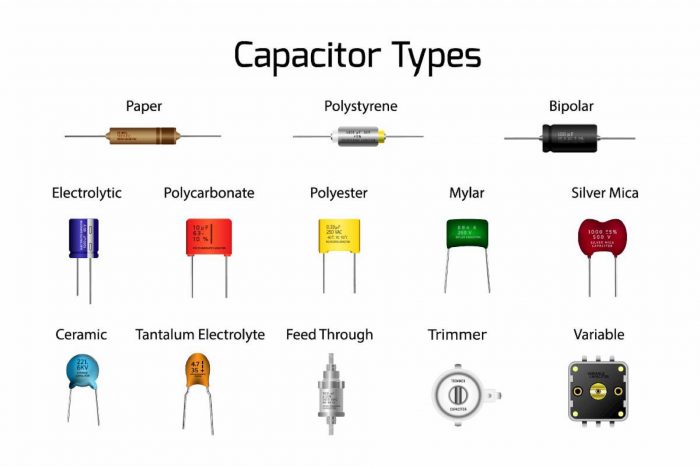

Ceramic capacitors
This are among the most common capacitors available and used in a large variety of circuit boards.
Capacitor are made by having two conductive plates, separated by an insulator and the electrons build up on one side,
(the voltage pushes them there!).
When the voltage is removed they flow back in the opposite direction. In this way they are able to store some of the electrons, a bit like a battery.
Ceramic disk capacitors are rated in pico Farads, (pF), or nano Farads, (nF). Typically, the value is written on the disk. In the example shown on the left image the value is 150000 pF or 150 nF. The first two digits are the first numbers of the value, the third digit is the number of zeros. This is the pF Value.
1st two digit 15 followed by 4 zeroes = 150000 pF
Electrolytic capacitors
Much esier to identify, the value is written on the case, along with the rated voltage.
This capacitor are “polarised”, which means you must put them in the circuit the right way round. On the casing you will see a stripe pointing to the -ve
That’s it for today, this was part 2 of the Basic components, on part 3 we will talk of Transistors.

Digital Designer, blog writer and also a tech enthusiast.
He loves to write content for blogs, podcasts, design websites, logos, brochures, banners and anything that sends a message to an audience.
You can contact Daniele at the link below: